

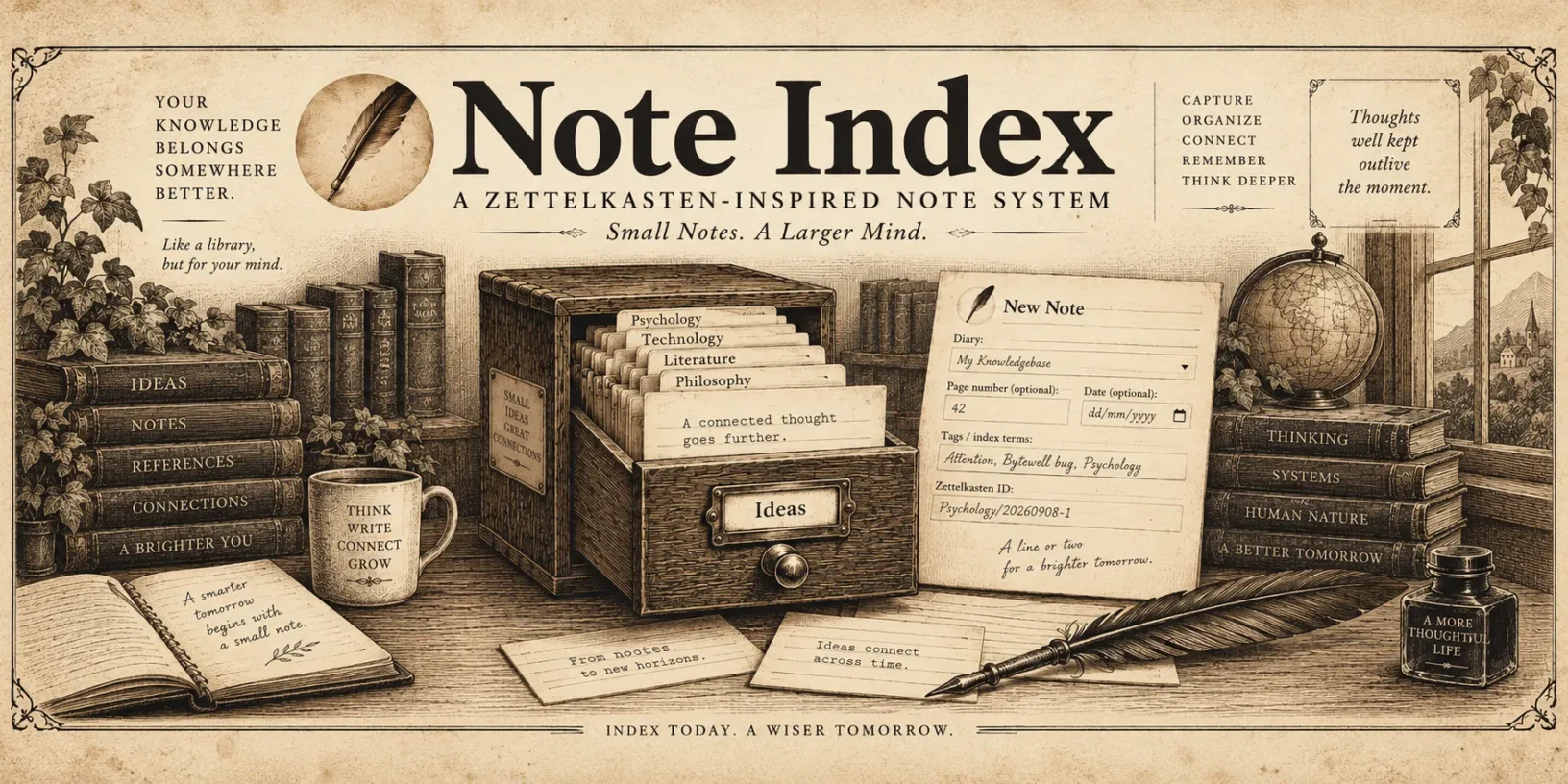

Last year, somewhere between an A6 index card and a three-hundred-page notebook, I lost track of my own thinking. Not the idea itself. The ID I’d given it.
I run a Zettelkasten scheme across notebooks, and I genuinely could not remember whether I had already used Psychology/11 or was about to write it twice by accident. That small, specific panic is what eventually became a piece of software.
This is the story of the year it took me to admit that no database was ever going to fix a book-shaped problem.
The habit that started all of this
I read constantly and messily, books and academic research papers alike. Physical copies, Kindle, free PDFs pulled into Moon Reader on a tablet.
I highlight heavily, but highlights were never enough for me.
I am, without much shame left about it, a fan of ancient library systems. Card catalogues. Ledgers. The physical discipline of a librarian who has to be able to find one specific reference among thousands. That probably makes me a fusion type by nature, someone who wants the feel of a vintage card catalogue and the convenience of modern software at the same time, not forced to pick one over the other.
So I write on A6 and A5 cards. I keep notebooks, some two hundred pages, some three hundred. I follow the Zettelkasten method because it genuinely fits how my mind works, not because it’s fashionable in productivity circles right now.
And I don’t stop at paper. I also keep digital notes in Notion, Logseq, and Obsidian, mostly around software and security engineering, alongside whatever I’m reading in blogs and papers that week.
Across every single one of those surfaces, physical or digital, I follow the same three or four habits without fail: a Zettelkasten-style unique identifier like Psychology/12092026/01, tags I can search against later, a page number when the note is physical, and a heading specific enough that I’ll actually remember what it means in six months.
Where every system I tried actually broke
I tried keeping a physical ledger, the accountant’s kind, one long running list. It didn’t survive contact with how much I actually write. Cross-referencing anything meant flipping between volumes with a finger holding my place in each one, which is a fine party trick and a terrible retrieval system. It became overwhelming fast, and I dropped it.
Then I tried Notion. This one lasted longer, and it should have worked. It’s flexible, it’s searchable, it has databases, and none of this is a knock on Notion itself, plenty of people use it well and get real value from it.
But at the exact moment I needed to retrieve something, under real pressure, it didn’t feel like retrieval for me. That’s a statement about my own experience, not a verdict on the tool.
It felt like anxiety. A specific, familiar kind of imposter syndrome where you know you wrote the thing down somewhere, and the not-finding-it becomes evidence against yourself rather than just a UI problem.
Neither one was close to what I actually wanted.
What I kept coming back to, without really admitting it to myself for a long time, was how an index at the back of a well-written book works.
Or how an academic paper closes with references you can walk straight to. That’s not a database. It’s a flat, alphabetical, unapologetically simple list of terms, each one pointing at exactly where to go. I’d been trying to build that shape inside tools that were never designed to hold it.
Building the thing I actually needed
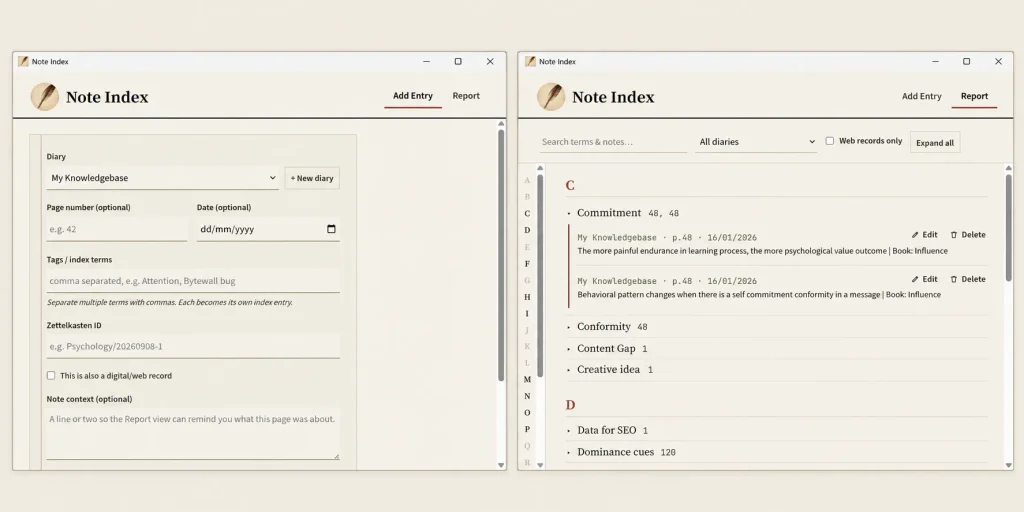
So I built it. It’s called Note Index, and I worked on it collaboratively with Claude Code rather than alone, which changed how fast the year-old idea finally became something real.
It runs fully local on a single SQLite file, which mattered to me for a reason that’s more personal than technical: I didn’t want to pay a server bill to keep my own memory retrievable. Right now it ships for Windows and Linux.
Linux specifically because my son Adi, an academic researcher and, by his own admission, another crazy note-taker, lives on Linux daily.
Mac support is next, not because it’s less important, but because it’s not where the two of us actually work yet.
I haven’t stopped at “it builds and runs.” Before putting it in front of anyone else, I ran it through VirusTotal and got zero detections (See report), because handing someone software to hold their private notes without checking that first felt like the wrong kind of shortcut.
The source itself stays private, which might sound like a contradiction for something I’m sharing in the open. But keeping the code closed and being honest about what it does aren’t the same thing.
So every release ships with its own scan report and file checksum, published where anyone downloading it can check for themselves instead of taking my word for it. I’d rather someone verify it than trust it.
Who this ended up being for
Zettelkasten practitioners tracking ID sequences across more notebooks than they can hold in memory.
Commonplace book keepers turning scattered quotes into one searchable list.
Students logging page numbers as they read, so a whole term’s notes stay reachable.
Researchers and writers who work physical-first and still want everything keyword-searchable later.
Diary keepers trying to find a recurring theme without re-reading four volumes, sometimes years apart.
And the people like me, straddling paper and screen at once, who need a note to carry a link to its digital twin without maintaining two separate systems of record.
What it does
The report screen groups everything alphabetically with a letter rail down the side, live search, and expandable entries, the way a real book index reads.
One index can span every notebook you use.
The Zettelkasten ID field is required on purpose, so the identifier never depends on you remembering what you wrote three notebooks ago.
An optional web link sits against any entry that also exists digitally.
And it stays fully offline: no account, no sync, no telemetry, nothing leaving your machine.
There’s a specific kind of relief in opening that report screen now and actually finding what I wrote three notebooks ago. It doesn’t fix the anxiety of forgetting something matters. It just makes the forgetting recoverable, and that turns out to be most of what I needed all along.
Frequently asked questions
What is a Zettelkasten ID?
A unique identifier, like Psychology/20260908-1, used in the Zettelkasten method to track and cross-reference notes. Note Index has a required field for it on every entry, so it’s never dependent on memory alone.
Does Note Index work without an internet connection?
Yes. Everything is stored in a single local SQLite file. No account, no sync, no cloud, and it makes no network calls.
Is Note Index free?
Yes, for Windows and Linux. macOS isn’t supported yet.
How is this different from Notion or Obsidian for indexing physical notes?
Those tools organize notes as pages or linked graphs. A book index is a flatter, purely alphabetical structure, term to page number, which is the specific shape neither tool is built around.