

Running both motions is easy. Deciding where they meet is the real work.
In plain terms, hybrid GTM is a go-to-market approach where a product lets individual users discover value and adopt it on their own, while a sales team steps in only once that usage signals real organisational demand. It blends bottom-up, product-led adoption with top-down enterprise selling, using each where it actually works. Neither motion runs the whole show; they hand off to each other at the point where organisational complexity shows up.
We build for the user. The buyer lives three floors up
A nurse manager finds a new workforce coordination tool between shifts.
She signs up and uses it to sort out handovers, team availability and the small daily juggling nobody writes into a job description. A colleague joins. Then another. A few weeks later, half the unit is on it. A couple of months later, other teams across the hospital have found it too.
We’d call that growth.
It is. It also hides a problem. Nobody in that chain can buy the product for the hospital.
Several floors up sits a different group of people, asking different questions. Can we trust this vendor? What will employees put into the system? Where is the data stored? Does it plug into our identity system? Who administers it? Does it pass security and compliance? What happens when someone leaves?
The nurse manager and the procurement team are looking at the same screen. They are not buying the same thing.
That gap is where bottom-up, top-down and hybrid go-to-market stop being slogans and become design choices. The question we usually start with is “product-led growth or sales?” The better one is this:
Who is the real buyer in B2B SaaS?
Let’s invent a healthcare workforce product and call it ShiftFlow.
For one hospital team, the pitch is simple. Spend less time coordinating routine work.
Now put ShiftFlow in front of a hospital network with 5,000 employees, and the room fills up. The nurse manager wants less coordination overhead. The department head wants staffing visibility. HR wants clean workforce processes. IT wants something it can administer and integrate. Security wants to know how data is handled. Procurement wants a vendor it can stand behind and terms it can sign. Finance wants the total cost.
So who is the customer?
In different ways, all of them.
None of this is new. Webster and Wind described organisational purchasing as a decision-making process back in 1972, and Johnston and Bonoma later mapped the buying center, the group of people and interactions behind an organisational purchase. [1][2]
What software changed is the order of events. We can now let someone inside the product before the buying center has decided anything. Once that door opens, adoption can run in either direction.
Top-Down GTM: How the enterprise sales motion works
Say ShiftFlow costs $300,000 a year and has to integrate with the hospital’s identity system, workforce systems and internal infrastructure. No nurse manager puts that on a credit card.
So the decision flows downhill:
Top-Down decision flow
-
CIO / Operations Director
-
Budget
-
IT + Security
-
Procurement
-
Contract
-
Hospital teams
The organisation commits first. The people who use the software meet it later.
This is the classic top-down enterprise motion, and seen from here, the expensive sales process makes sense. Security reviews, integration, migration, compliance, procurement and legal aren’t obstacles wrapped around the purchase. They are part of the purchase. Spending tens of thousands of dollars to acquire a $20-a-month customer is absurd. Spending it to land a contract worth hundreds of thousands is arithmetic.
There’s a cost we rarely count, though. An organisation can buy software the people inside it never adopt.
Top-down failure
- Purchase
- YES
- Usage
- NO
Most of us have met this software at work. It exists. We have logins. Someone even ran a training session. And almost nobody opens it.
Bottom-Up GTM: How Product-Led adoption works
Now lower the barrier. ShiftFlow gets a free tier for small teams.
A nurse manager hears about it from a colleague, creates an account and plays with it. No demo. No procurement. No salesperson. No hospital-wide rollout.
She gets value first. Then a colleague joins, then the unit, then the unit next door. The direction flips.
Bottom-Up decision flow
-
Organisation
-
Department
-
Team
-
Individual
Traditional enterprise software asks an organisation to buy before its people can discover value. Bottom-up reverses the order:
Discover value first
-
Use
-
Value
-
Spread
-
Purchase
That also lets us pull apart two terms we tend to blur. Product-led growth is the mechanism: the product itself does the work of acquiring, activating, retaining and expanding usage. Bottom-up GTM is the direction: individual to team to department to organisation.
They feed each other. Self-service makes bottom-up possible, because nobody needs an enterprise buying process to find out whether a tool is useful. And product design can carry adoption from one person to the next. Sinan Aral and Dylan Walker tested this with 9,687 Facebook users and their 1.4 million friends, and found that viral product features produced measurable peer influence and social contagion. Their setting was a social network, not B2B SaaS, so we shouldn’t lift their numbers into enterprise software. The mechanism still holds our attention: how we design the product shapes how adoption moves between people. [3]
For collaborative software, sharing stops being a feature. It becomes distribution.
Usage changes the sales conversation
Let’s imagine we are selling ShiftFlow to a hospital network.
We could tell the operations director:
Your teams will love this.
That’s a promise.
But what if we could instead say:
Several teams across your hospital are already using this every week.
Now we are having a different conversation.
The product has produced some behavioural evidence before the enterprise sale has even begun.
We are no longer talking only about what might happen.
Something is already happening.
This may be one reason bottom-up adoption doesn’t necessarily make enterprise sales less important.
It can make sales enter with better information.
McKinsey describes a related approach as product-led sales, where product usage and analytics can help sales teams identify product-qualified leads and accounts. Instead of relying only on something like a white-paper download, a company can look for evidence that people inside an account have actually experienced value from the product. [4]
That feels different from:
But can usage fool us too?
Say ShiftFlow hits 10,000 free users. Impressive.
Keep counting. 600 become meaningfully active. 100 form teams. Twelve healthcare organisations build substantial usage. Three become enterprise customers.
Those 10,000 signups look different now.
Robert Fichman and Chris Kemerer studied a related problem long before anyone said “PLG”. Their work on the assimilation gap showed that a technology could be widely acquired yet barely deployed inside the organisations that acquired it. [5]
Modern freemium hands us the mirror image:
- Usage
- Yes
- Purchase
- No
Free adoption is not a business. A study by Pei-Fang Hsu, Hsin-Ru Rebecca Yen, Paul Jen-Hwa Hu and Tuan Kellan Nguyen, published in Information Systems and e-Business Management, drew on data from 638 active SaaS users. Unlike earlier work that stopped at intention to pay, it looked at actual purchasing behaviour too. Perceived value and satisfaction were connected to both, with price consciousness and the fit between perceived value and premium needs also playing a role. [6]
So we land on an odd symmetry:
Top-down
- Purchase
- Yes
- Usage
- No
Bottom-up
- Usage
- Yes
- Purchase
- No
What is Hybrid GTM?
ShiftFlow doesn’t phone every nurse manager who signs up. One user arrives, and we let her explore. Five people from the same hospital show up, and we still wait.
Then several units appear. Usage turns regular. Managers log in. What looked like a few curious individuals starts to look like something happening inside an organisation.
Now the journey looks like this:
-
Individual discovers product
-
Experiences value
-
Team adoption
-
Organisational usage
-
Product-qualified account
-
Sales enters
-
Security + IT + Procurement
-
Hospital contract
-
Organisation-wide rollout
The salesperson didn’t disappear. They arrived later, at the moment the problem became organisational. The product handled the stretch it could handle cheaply and naturally. People took the stretch that needed people.
ICONIQ’s 2026 State of GTM research, drawing on data from more than 150 B2B software GTM leaders, suggests this blend is becoming normal. High-growth firms in its dataset projected roughly 20% of revenue from self-serve in 2026, against around 10% for their peers. Seller and channel-generated pipeline still accounted for 60 to 80% of pipeline among those high-growth companies. And 48% of companies in the sample primarily use hybrid pricing models. [7]
So the story isn’t “PLG is replacing sales.”
The handoff is the hard part
Saying “we do PLG and enterprise sales” costs nothing. Deciding where they meet costs a lot.
Reach out too early and we wreck the low-friction experience that made bottom-up adoption work in the first place. Wait too long and organisational demand builds inside the product while nobody is watching.
“Someone signed up” is a thin signal. Richer ones sound like this. How many people from the organisation are active? Are they collaborating? Is usage repeating? Are multiple teams appearing? Have managers or administrators joined? Is the account brushing against limits where governance or enterprise support starts to matter?
The exact signal differs for every product. The question underneath doesn’t. We move from “who filled in our lead form?” to something sharper:
The moment we ask that, product analytics, sales, marketing and product design end up in the same room.
The product changes as it climbs
Watch what ShiftFlow becomes on the way up.
At the bottom, it’s help me coordinate my team’s work. At the unit level, help us coordinate across shifts. At the hospital, help us understand and manage workforce operations. At the network, give us a secure, governable workforce coordination platform.
Same product. Different purchase.
The nurse manager asks for a faster workflow. The enterprise buyer asks for SSO. Employees want easy; IT wants administrable. Individuals value autonomy, and organisations need governance.
Which leaves us with a product question, not a sales one:
A tool born for one person will eventually meet enterprise requirements it was never designed to handle. That’s where GTM architecture starts touching product architecture.
Pricing climbs with it
-
Free small team
-
$20 individual plan
-
$200 team
-
$20,000 department
-
$200,000 hospital network
At the bottom, we sell convenience. Then coordination. Near the top, we sell administration, security, governance, support and organisational infrastructure.
The commitment changes on every floor, so pricing often changes with it. That is why GTM and pricing tend to evolve together. ICONIQ’s 2026 report found that 48% of companies in its sample reported hybrid as their primary pricing model, with consumption-based pricing structures on the rise. [7]
Can Hybrid GTM start Top-Down?
So far we’ve been climbing. Let’s run it the other way.
A hospital network signs an enterprise agreement, and thousands of employees onboard themselves.
-
Enterprise agreement
-
Employees self-onboard
-
Teams form organically
-
Usage expands
Top-down purchase and bottom-up adoption, in the same motion. Or teams adopt first, an agreement follows, and the agreement opens the door to thousands more. Hybrid refuses to be drawn as one tidy funnel. It’s a set of adoption paths pushing on each other.
Frambach and Schillewaert’s framework for organisational innovation adoption helps here, because it treats adoption at two levels at once: the organisation, and the individual adopter inside it. [8]
Practitioners draw:
-
User
-
Champion
-
Enterprise
Researchers use a different vocabulary. We’re describing the same system from two ends. Individual acceptance and organisational adoption shape each other.
They just aren’t the same event.
Where organisational friction enters
Two situations.
A lightweight coordination tool. We find it, create an account, invite a couple of colleagues, and within half an hour we know whether it helps.
Now let’s consider replacing a hospital’s core workforce-management platform. Before any value shows up, we need data migration, identity integration, a security assessment, training, procurement, change management and executive approval.
We can call the difference organisational friction. Not the friction of a confusing interface. The friction of more parts of an organisation having to coordinate before the product can do anything useful.
A useful mental model, rather than a literal equation, is:
This is a lens, and it asks us a handful of plain questions.
- Can one of us get real value alone?
- Can we bring a colleague in?
- Does collaboration raise the value? When do we need permission?
- When do security, integration, compliance or procurement show up?
- And by then, is the account valuable enough for human help to pay off?
Research on hybrid B2B selling gives us another useful clue. Kanuri and colleagues studied businesses adding direct online channels alongside field sales. Their analysis found that moving some buying tasks online could free salespeople to redirect their effort towards other selling opportunities. [9]
Perhaps the question was never whether software or people should sell. Maybe it’s this:
Product-Led or Sales-Led? Are we asking the wrong question?
For years, one diagram did the rounds:
Two competing philosophies. Choose one.
But the more we follow a real buying journey through an organisation, the harder that binary becomes to maintain. Different questions begin to take its place.
- Who feels the pain?
- Who can try the product without asking permission?
- Who experiences value first?
- Who controls the money?
- When does organisational friction appear?
- What behaviour tells us individual usage is turning into organisational demand?
- When would a salesperson make the journey genuinely better?
Asked together, those questions turn GTM into a system-design problem. Product, marketing, sales and customer success become different actors doing different work at different moments.
That’s also why hybrid isn’t easier. Free users, paid individuals, teams, enterprise customers, self-serve pricing, negotiated pricing, marketing leads, product-qualified accounts, sales territories and customer success all live inside one system.
Designed badly, they fight each other. Designed well, one motion feeds the next.
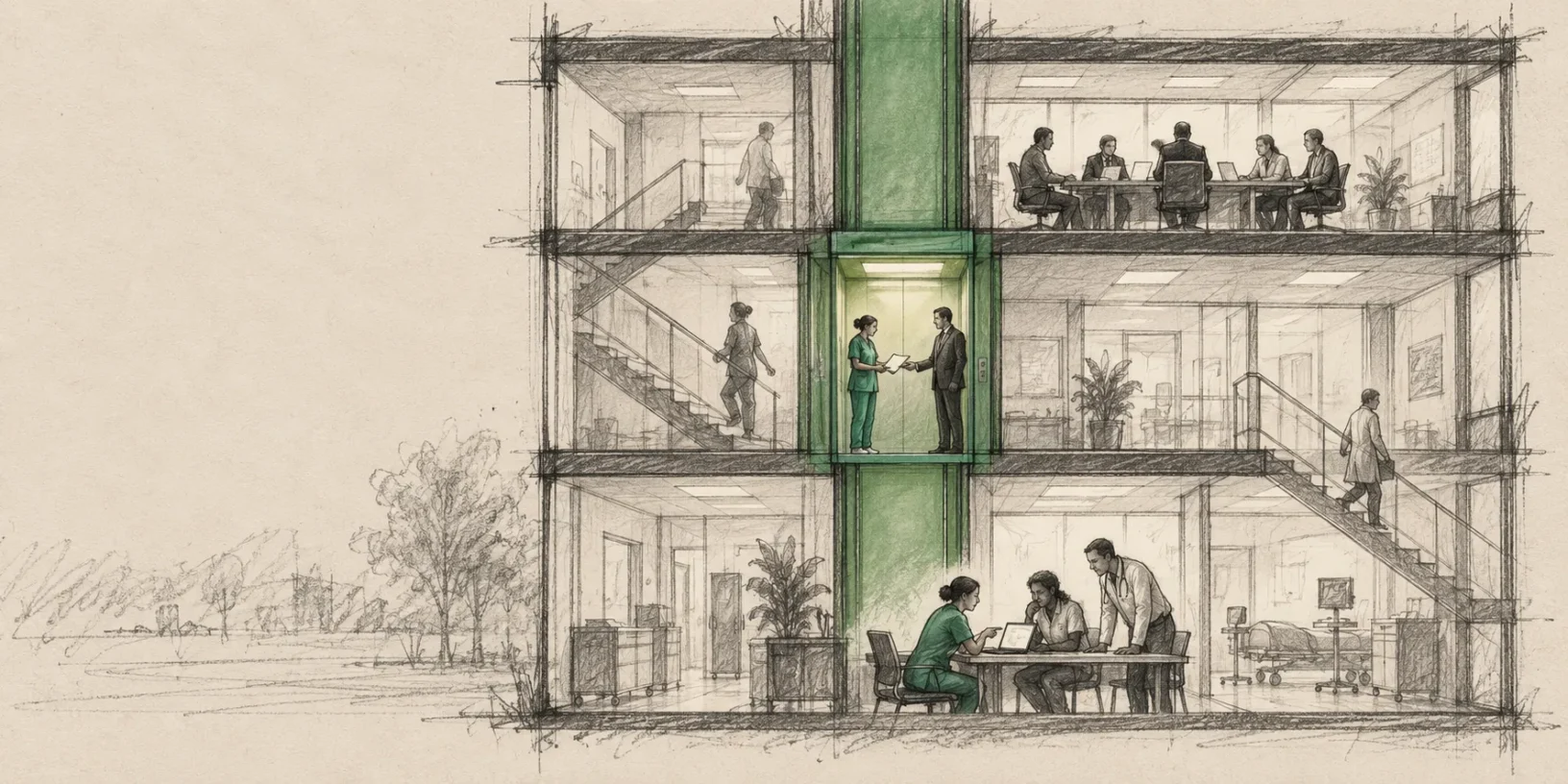
What if we picture the organisation as a building?
This is the mental model I keep coming back to.
Let’s picture an organisation as a building.
At the bottom are the people experiencing the problem every day.
Above them are team leads and champions.
Above them are budget owners.
Higher again sit economic buyers and the people who make an organisation-wide commitment possible.
Who sits on each floor?
-
CEO / CIO / CFOEconomic buyer
-
VP / DirectorBudget owner
-
Manager / Team leadChampion
-
Individual usersExperience the problem
Top-down starts upstairs. The organisation buys, and adoption has to travel down.
Bottom-up starts downstairs. People use the product, find value, and adoption tries to travel up.
Maybe Hybrid builds the elevator.
The product can create movement from below. Sales can help when the journey reaches organisational complexity. Sometimes someone steps in downstairs. Sometimes the call comes from the top floor. Often, both happen at once.
Which puts us back beside the nurse manager, between shifts, holding a tool she loves and no authority to buy it. Product-led or sales-led was never the interesting question. This one is:
We don’t have a clean answer yet. But once we ask it, we stop staring at a marketing funnel and start seeing the building it was drawn on.
References
- Webster, F. E. Jr., & Wind, Y. (1972). A general model for understanding organizational buying behavior. Journal of Marketing, 36(2), 12–19. https://doi.org/10.1177/002224297203600204
- Johnston, W. J., & Bonoma, T. V. (1981). The buying center: Structure and interaction patterns. Journal of Marketing, 45(3), 143–156. https://doi.org/10.1177/002224298104500312
- Aral, S., & Walker, D. (2011). Creating social contagion through viral product design: A randomized trial of peer influence in networks. Management Science, 57(9), 1623–1639. https://doi.org/10.1287/mnsc.1110.1421
- Alaghband, M., Panagiotidou, N., Roche, P., & Schneider, J. (2023). From product-led growth to product-led sales: Beyond the PLG hype. McKinsey & Company. McKinsey article
- Fichman, R. G., & Kemerer, C. F. (1999). The illusory diffusion of innovation: An examination of assimilation gaps. Information Systems Research, 10(3), 255–275. https://doi.org/10.1287/isre.10.3.255
- Hsu, P.-F., Yen, H.-R. R., Hu, P. J.-H., & Nguyen, T. K. (2025). Converting free users to paying customers in freemium services: A SaaS success model. Information Systems and e-Business Management, 23, 355–390. https://doi.org/10.1007/s10257-024-00690-2
- ICONIQ Growth. (2026). State of Go-to-Market 2026. Research based on data from 150+ B2B software GTM leaders. ICONIQ report
- Frambach, R. T., & Schillewaert, N. (2002). Organizational innovation adoption: A multi-level framework of determinants and opportunities for future research. Journal of Business Research, 55(2), 163–176. https://doi.org/10.1016/S0148-2963(00)00152-1
- Kanuri, V. K., Habel, J., Chaker, N. N., Rangarajan, D., & Guenzi, P. (2022). B2B online sales pushes: Whether, when, and why they enhance sales performance. Production and Operations Management, 1–21. https://doi.org/10.1111/poms.13927